When Visual Insight Is Missing: Furnace Cameras as a Tool in the Final Commissioning Phase at Din Forsyning
The commissioning of the wood-chip boiler at Din Forsyning in Esbjerg has taken place over an extended period and as is often the case with complex energy plants, has involved multiple disciplines and ongoing adjustments along the way. In the final phase of commissioning, however, a clear challenge remained: gaining reliable insight into what was actually happening inside the furnace.
Emission levels were still too high, and it was difficult to assess how changes to air distribution, fuel input, and other parameters affected the combustion process itself. At the same time, operational disturbances made it challenging to determine whether active combustion was still taking place inside the furnace.
As a result, decisions were largely based on indirect process measurements and trends, without direct visual confirmation from inside the furnace.
Furnace cameras were not part of the original boiler design
When the boiler was originally designed, the installation of furnace cameras had not been considered. No dedicated camera ports or reserved space for visual monitoring were included in the furnace layout.
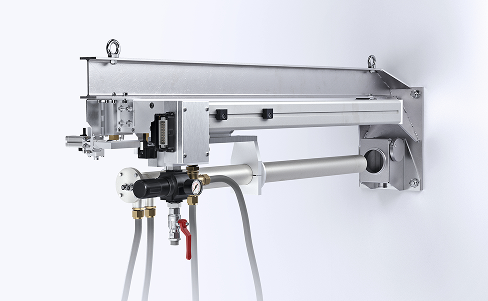
This ruled out a conventional straight-view camera installation unless structural modifications were made to the boiler. To establish visual insight quickly and without altering the boiler construction, the decision was made to install a DURAG demo furnace camera with a 60° elbow viewing configuration (VIS6060).
The angled configuration allowed the camera to be mounted in an existing blind flange in the boiler wall while still providing a relevant and comprehensive view of the furnace interior
VIS6060 enabled insight where straight insertion was not possible
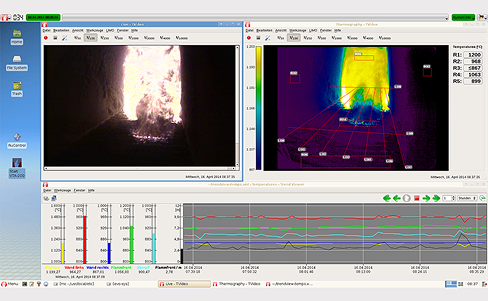
With the 60° elbow viewing direction, it became possible to observe several critical areas inside the furnace, including:
- the air nozzles
- the furnace bottom
- the fuel feeding zone
The combination of viewing direction and field of view proved decisive. The camera did not simply provide images—it delivered actionable visual insight that could be directly linked to adjustments made during the commissioning process.
From indirect indicators to focused adjustments
The camera image was displayed on a screen in the control room, allowing operators and commissioning personnel to continuously monitor furnace conditions while adjusting air, fuel, and other parameters.
This changed the working approach in the final commissioning phase. Instead of relying solely on how adjustments affected emission values and trend curves over time, the impact could be observed immediately inside the furnace.
The project in Esbjerg clearly demonstrated how visual insight can make the difference between commissioning based on indirect process indicators and a more focused, effective commissioning process.
Once the camera was installed, it quickly became clear which corrective actions were required to move commissioning forward.
Simple installation – also suitable as a temporary solution
One of the key experiences from the project was how straightforward the camera installation proved to be once a suitable insertion point in the boiler wall was identified.
The installation required only:
- cooling water
- compressed air
- a power supply
Additional cabling for image display and system integration depends on the chosen setup.
This simplicity makes the solution suitable not only as a permanent installation, but also as a temporary commissioning tool. Furnace cameras can be used to:
- support combustion tuning during commissioning
- assist troubleshooting during operational challenges
- provide visual insight during specific operating phases
If required, the camera can later be permanently integrated or removed again.
Practical experience from the field
The installation and use of the furnace camera were carried out by Sirius Energy consultants Casper Dalgaard and Lasse Tordrup Bach, both of whom have hands-on experience with operating and commissioning energy plants.
The Esbjerg case clearly showed how visual insight supports collaboration between operations and commissioning teams and makes it easier to understand the relationship between control settings and actual combustion behaviour.
Furnace cameras as decision support in the final phase
The case at Din Forsyning highlights an important point: furnace cameras create value when they are actively used as decision-support tools - not merely installed as monitoring equipment.
In this project, the angled VIS6060 configuration became a decisive tool in the final phase of commissioning, where clarity and targeted adjustments were most critical. The result was a stronger decision basis, faster progress, and increased confidence in ongoing operation.
The right solution starts with the right dialogue
Every plant is different. Space constraints, furnace geometry, and operational challenges all influence which furnace camera solution delivers the greatest value.
If you are in the middle of a commissioning process - or considering whether a furnace camera could provide better insight into your plant - Sirius Energy can support the evaluation. Early technical dialogue often makes the difference between installing a camera and gaining a tool that truly supports daily operation.